Owlskip Games, primarily comprised of former ZA/UM developer Tim Sheinman, has been making investigative games for many years. Excellent titles like Family, Rivals and Riley & Rochelle required players to delve into documents, musical archives, and personal effects to piece together mysteries, family trees, and intricate timelines. And if you’re thinking, “Gosh, that sounds like 2025’s smash hit The Roottrees Are Dead,” then pour one out for Sheinman who was doing it years before. His latest, out today, is The Ratline, and it’s all about hunting down Nazis.
Set in 1971, it casts you as a private detective tasked by a mysterious figure with tracing down various Nazi war criminals who escaped justice. Living new lives under assumed names, as was very much the case in reality, these senior members of Hitler’s regime are now dentists, wine merchants, perhaps even senior members of South American police forces, and with the scant documentation you’re handed, you need to find them.
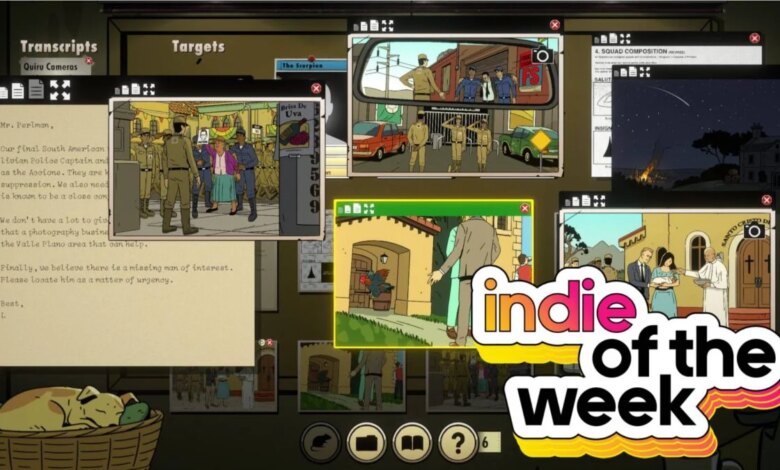
This all plays out on a pinboard, above a desk with a telephone, rolodex and radio, and requires you to dig through documents, research points of interest, and pick up the phone and talk to people who might be able to help. You’ll also gain access to photographs, business cards, private letters, and all manner of other scraps of paper, and from these you’ll need to piece together the real names and present locations of each chapter’s targets. Fill it all in, get it right, and you’ll move on to the next mystery.
The Ratline, which is named after the systems of escape from Europe used by Nazis and collaborators after World War II, is an oddly scrappy game, having you both juggling piles of paperwork around a pinboard, but also somehow being able to type keywords into some sort of anachronistic machine that’ll return more paperwork in return. As unlikely as it might be, it’s sometimes a neat system, but then too often fails to return results for pretty obvious keywords. Requiring even more of a complete suspension of disbelief is the way in which people you speak to on the phone, as far away as other continents, are able to get you photographs and documents within seconds of hanging up. It’s all necessary for the game to function, but it is very odd and a touch silly. It would have been better, I think, to just write the long stretches of waiting into the story, acknowledging the week that goes past before the photos show up, even if it’s just a caption on screen.
However, after a couple of cases you just sort of accept the conceit and crack on. Perhaps this takes place in another universe where technology is inexplicably muddled in the early ’70s? Yeah, that’ll do—let’s get on with tracking down those Nazi fuckers.

It’s extremely satisfying to crack a case. In Chapter 5 (The Case of the Sunburnt Nazi) I was delighted when I realized that I had been ignoring the Spanish translation of the declassified CIA document to my detriment, and from that moment it all began to fall into place. And for when things are just too tricky (and this is a hard game), you can take advantage of the built-in hint system to keep you moving forward, with every detail offering a nudge, a heavier hint, and then just the solution.
However, to stop you from relying on these hints too early, let me give you a piece of advice that the game really should include itself: Don’t forget your previous cases. If you’re completely stuck, stick the key names of your current case into the search boxes of your Evidence Journal, and it’ll return any previous time that name or place came up. Oh, and don’t forget to give the puppy a stroke now and then. It changes nothing, but the little dude’s always there, patiently dozing. (Although it would make so much more sense to have the rolodex where he is, and the doggo to the right—you’ll see what I mean.)

For all the oddities and scrappiness, and you’ll definitely encounter moments of bemusement, it’s a big pleasure to start a new case, find the right number to call, receive a new packet of photographs to scour, and start piecing things together. It’s nice to have a game that makes me want to take notes on a pad in front of me (you don’t have to—every conversation is transcribed and no documents disappear—but it helps me organize my thoughts), and to allow myself to slow down. It’s good to not feel a need to immediately solve everything or demand a clue, but rather allow myself to muse, or even Google bits and pieces to see if it inspires an idea, and then come back to the game with new thoughts.
The Ratline is out now on Steam for $11.99.
Source link