
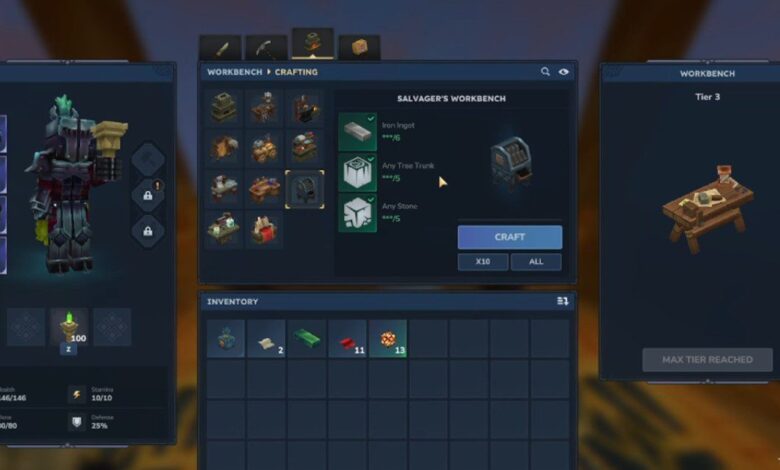
Upgrading workbenches in Hytale sounds simple on paper… until you actually try to do it. Suddenly you’re staring at material names you’ve never seen before, wandering into biomes you weren’t prepared for, and questioning whether that drop even exists yet. Since Hytale is still in early access, a lot of this can feel confusing or unfinished, so I put together this full guide to walk you through every workbench, every upgrade tier, and where to actually get the materials without losing your sanity.
Upgrading the Workbench (Tier 1 to Tier 3)
Workbench Upgrade (Tier 1 to Tier 2)
The original Workbench (Tier 1) is the backbone of everything, so this is where you’ll start. The early upgrades are friendly enough. Copper and iron ingots come straight from caves in the forest biome. Iron tends to sit deeper in caves, while copper can show up almost anywhere inside. Linen scraps are just as simple once you know the trick: kill enemies that are wearing clothes. Skeletons inside small structures are perfect for this, and you’ll usually get linen scraps very quickly. That sums up your upgrade to Tier 2.
Workbench Max Upgrade (Tier 2 to Tier 3)
Things ramp up once you push toward tier three (Tier 3). You’ll need thorium ingots, cobalt ingots, heavy leather, shadow weave scraps, and essence of fire.
Thorium is easiest to find in desert mountain ranges, where it spawns directly on mountain sides and is easy to spot thanks to its green crystals and the sharp ridges on the map. Cobalt works the same way, except it lives in snowy mountain regions and is just sitting out in the open.
Heavy leather starts as heavy hide, which drops from large animals like polar bears. Take that hide to your tanning rack and you’re good. Essence of fire comes from fire-type enemies deep underground in the starting green biome. Fire golems are the obvious choice, but fire mages, fire skeletons, and candle-headed goblins also drop it. Shadow weave scraps come from humanoid enemies in snowy villages, and there are plenty of those scattered across the map.
Once all of that is collected, your original workbench hits tier three and is fully maxed for now.
Builder’s, Armorer’s, and Arcanist Workbenches
The builder’s workbench is refreshingly simple, since it doesn’t have upgrade tiers at all.
The armorer’s workbench, however, takes a bit more effort. Tier one and two require copper ingots, bone fragments from skeletons, medium leather from medium-sized animals or armored beasts, and Azure logs. Azure logs come from blue-tinted regions in the starting area, where the trees themselves are visibly blue and easy to identify.
Tier three is where things get spicy. You’ll need thorium, cobalt, shadow weave scraps, sturdy chitin, and a void heart. Sturdy chitin drops from armadillos in the desert, usually one to three at a time. I’ve had the best luck finding them in hardened clay areas rather than pure sand, though those zones are packed with dangerous enemies like hyenas and alligators.
The void heart is the real grind. It drops from purple void enemies that spawn at night in any biome, and it’s extremely rare. I only managed to get a couple in an entire day of playing, so expect to farm night mobs for a while. Once you have one, you can finally max out the armorer’s workbench.
The Arcanist workbench currently stops at tier one, so there’s nothing extra to worry about there.
Alchemist, Chef, and Farmer Workbenches
The alchemist workbench requires silver, gold, boom powder, and bone fragments. Boom powder drops from bomb-throwing goblins, which are far more common in desert and blue-tinted regions than in the starting biome. Silver is most common underground in snowy areas, while gold shows up underground in desert and fire regions. Tier two is currently the highest level for the alchemist workbench.
The chef’s stove is capped at tier one for now, so there’s no long grind here.
The farmer’s workbench is the most straightforward but also the longest to fully upgrade. Essence of life comes from crops and plants, and you’ll constantly need logs alongside it. Early tiers revolve around wheat and lettuce, while later upgrades introduce carrots, corn, cauliflower, turnips, pumpkins, eggplants, tomatoes, and chilies. Higher tiers demand massive amounts of essence of life.
Eventually, you’ll hit tier eight, which requires blood petals, storm petals, and Azur petals. As of now, these don’t appear to exist in the game. I haven’t found them in any biome, and upgrading past this point doesn’t seem to change anything, so the final farmer tiers are effectively locked for now.
Furnace, Tanning Rack, Feeding Trough, and Blacksmith Anvil
The furnace only upgrades to tier two and uses materials we’ve already covered above. The tanning rack has a single upgrade level and relies on sturdy chitin and leather from animals or armored beasts. The feeding trough also only has one level.
The blacksmith anvil is a bit more interesting. Tier one requires linen scraps, light leather, iron ingots, and venom sacks. Venom sacks drop from spiders at night in the starting biome, flying beetles in the desert, and several other creatures across the world. Tier two is much easier by comparison, requiring essence of fire, essence of ice from ice enemies in snowy biomes, and essence of void from nighttime void enemies. Once that’s done, the anvil is fully maxed.
Wrap-Up
And that’s everything you need to upgrade every workbench in Hytale as far as early access allows. Some upgrades are smooth, others are a grind, and a few are clearly waiting on future updates, but at least now you know exactly where to go and what to hunt for.
If you find yourself stuck on certain upgrades that need darkwood, especially after accidentally grabbing the wrong logs like I did, you’ll definitely want to check out my guide on Darkwood Trunk Location in Hytale. When you want fancy upgrades, but the trees are chillier than you are, that guide will save you a lot of wasted climbing and disappointment.
Source link