
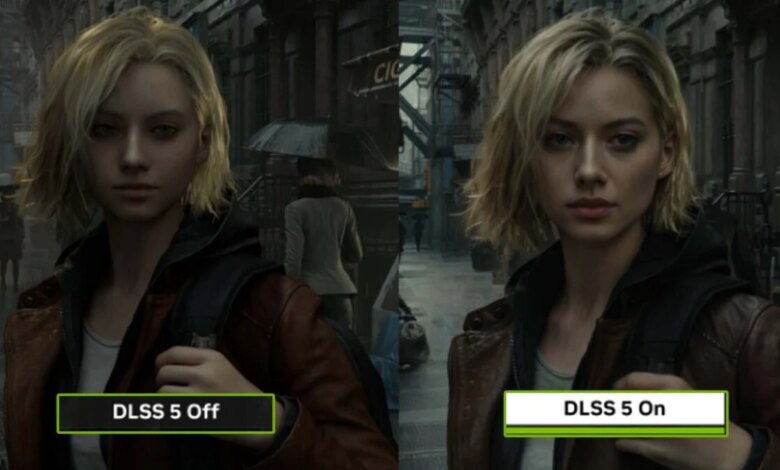
Today, GPU maker and tech giant Nvidia revealed DLSS 5, a new version of its existing upscaling technology that, based on the first images shared by the company, will slap a nice coat of AI slop onto in-game faces.
On March 16, Nvidia announced the next evolution of DLSS, calling DLSS 5 the company’s “most significant breakthrough in computer graphics since the debut of real-time ray tracing in 2018.” Nvidia’s CEO Jensen Huang called the new tech the “GPT moment” for video game graphics, saying that it blends “hand-crafted rendering with generative AI to deliver a dramatic leap in visual realism while preserving the control artists need for creative expression.” And uh, I have some doubts about that last point. Or really everything.
In the blog post announcing DLSS 5, Nvidia showed off numerous examples, and all of the DLSS 5-enhanced screenshots of Grace in Resident Evil Requiem look like the kind of crap that gets made by angry fans online when they think a woman has too big a chin.
According to Nvidia, here’s how DLSS 5 works (and also why it looks so bad).
DLSS 5 takes a game’s color and motion vectors for each frame as input, and uses an AI model to infuse the scene with photoreal lighting and materials that are anchored to source 3D content and consistent from frame to frame. DLSS 5 runs in real time at up to 4K resolution for smooth, interactive gameplay.
Basically, as described by Nvidia, each frame of the game is being covered in real-time with AI junk that is trying to mimic realism but ends up just creating a really off-putting image that also doesn’t look at all like the original game. Previously, DLSS tech helped games run better by letting the PC render the game at a lower internal res and using AI to upscale it to something better-looking. The results were often impressive. But this…this is something else, and it makes it look like someone ran Resident Evil Requiem through some cheap photo filter.
And it wasn’t just Resident Evil that got slopped up. Nvidia also applied DLSS 5 to Starfield to try to improve that game’s admittedly rough-looking faces. The end result:

Yikes! Other games that Nvivia “enhanced” with DLSS 5 included Hogwarts Legacy and EA Sports FC. The results also look like AI slop! Look out for that older woman in the Hogwarts video who looks especially rough after being improved with AI and DLSS 5. And also notice how little footage Nvidia shows of the games in motion using DLSS 5. I think that’s because it looks so unnatural and odd in motion.
Nvidia says DLSS 5 will be available later this fall in a list of titles including AION 2, Assassin’s Creed Shadows, Black State, CINDER CITY, Delta Force, Hogwarts Legacy, Justice, NARAKA: BLADEPOINT, NTE: Neverness to Everness, Phantom Blade Zero, Resident Evil Requiem, Sea of Remnants, Starfield, The Elder Scrolls IV: Oblivion Remastered, Where Winds Meet, and “more.”
“Bethesda has such a rich history pushing graphics with NVIDIA, going all the way back to Morrowind, with that incredible water,” said Bethesda game director Todd Howard via a statement shared by Nvidia. “When NVIDIA showed us DLSS 5, and we got it running in Starfield, it was amazing how it brought it to life. We’ve played it. We can’t wait for all of you to do so as well.”
I’m probably going to pass on that one, Todd. But thanks anyway.
The internet doesn’t like DLSS 5
As you’d expect, the internet has reacted poorly to the reveal of DLSS 5 and its AI slop faces, with many people pointing out how drastically altered some of the images are from the original source material and questioning who would want this.
Source link