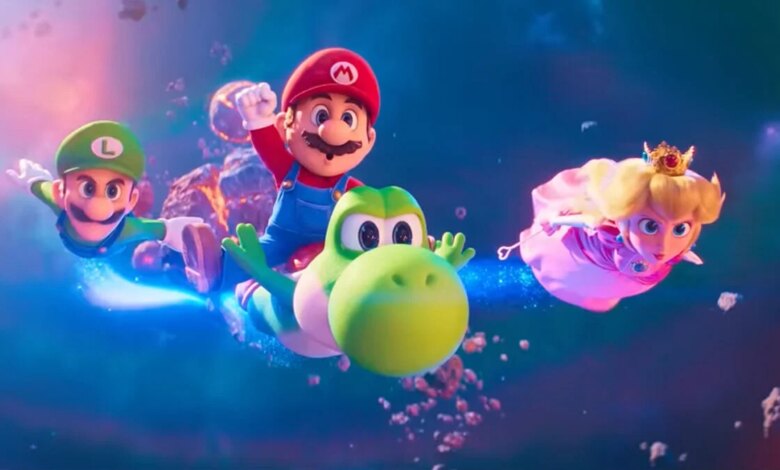
Games, I think most would agree, can be in some ways absorbing and still be bad. Perhaps a particular game has little to offer beyond showering us with loot or just making numbers go up, and even while we feel the pleasure chemicals release in our brain in response to these stimuli, we know they’re empty calories. There’s nothing of actual value or substance there, just a sugary distraction, and we’re aware, even as we let the nothingness eat up hours of our time, that we could be playing something that’s enjoyable and rewarding in a more meaningful way. We know that, despite the fact that it makes us feel good, it’s not actually good.
The Super Mario Galaxy Movie is the cinematic equivalent of this type of game. Like its predecessor, the slightly less terrible Super Mario Bros. Movie, it trots out a host of characters, sound effects, and easter eggs sure to make the brains of longtime Nintendo fans, myself included, light up with recognition. What it doesn’t do is build any kind of remotely engaging story around them, anything with genuine stakes or peril or pathos or even real humor. Instead we’re whisked from one arbitrary situation to another to another, each one just an excuse for a few more unremarkable jokes or a new action set piece.

And to be fair, the action here is competent and the animation is technically impressive. The film was made by Illumination, the studio responsible for the Minions movies, and its animators are proficient in the visual language of cinema. At times throughout Galaxy, I was reminded of Jurassic Park, Return of the Jedi, Star Trek II, and other good and memorable films. But all of those films have qualities of their own to stand on. What Galaxy sorely lacks is enough originality of its own to make the trip worthwhile. The high point of visual creativity occurs when Peach goes to a casino in which visitors can walk on any wall, reminding me both of Fred Astaire’s legendary dance on the walls and ceiling of a room in 1951’s Royal Wedding and of the imaginative design of a great Mario level. But these fleeting glimpses of originality aren’t enough in a film mostly content to trot out the familiar and say, “Remember this?”
That casino is also where Peach meets Wart, the final boss of Super Mario Bros. 2, voiced here by Luis Guzman, and while he doesn’t get much screen time, he’s one of the film’s few welcome surprises. Here, Wart becomes a slightly off-kilter crime lord in a fresh characterization that makes me see the character in a new way. Everyone else, from Benny Safdie’s Bowser Jr. to Glen Powell’s Fox McCloud, is exactly what I expected them to be, and incredibly shallow versions of them at that. (Fox does get the film’s other visual highlight, though: an anime-style summary of his backstory.) Mostly, the film feels desperate. Desperate to please, desperate to hold our attention, desperate to hit all the triggers that might make us sit up in our seats and re-enact the meme of Leonardo DiCaprio pointing in recognition at something. (Yes, there’s a “Do a barrel roll” reference.)
What I find so disheartening about this isn’t just that these films are empty products. It’s that in the world of game design, there are few developers I’d consider less likely to make games of the empty calorie variety than Nintendo. Shigeru Miyamoto is a producer on both the Bros. and Galaxy movies, and seems by all accounts to be heavily involved in their production. He’s also the genius whose creative vision drove the design of games like Super Mario Bros. and The Legend of Zelda, games that challenged me and every other ‘80s kid who played them on the NES around the time they were released.

These games were immensely rewarding to play, but they made us earn that feeling of satisfaction. I still remember the way my pulse would start racing every time I reached world 8 in Super Mario Bros. and knew I had to face the unpredictability and danger of the Hammer Bros. What made that game so great, in part, was the way it pushed players to overcome those challenges. The Super Mario Galaxy Movie asks nothing of us but that we sit back and let it all wash over us like a warm bath.
As reviews of this film have come out, some of them quite negative, a number of viewers have responded with things like, “It’s for kids! What do you expect?” Well, first of all, it’s not entirely for kids. There’s a joke in there about how slowly R.O.B.’s arms move, and while I know that many kids have become familiar with R.O.B. from his appearances in Super Smash Bros. games and the like, the only people who are going to really feel that joke in their bones are those who, like me, actually played Gyromite once upon a time and remember waiting for his little arms to move. But still, yes, on the whole those people are right. The film is primarily for kids.
And no, I don’t expect a movie for kids to be challenging in the way that a game can be challenging. However, children are people too, people whose imaginations and understandings of the world are expanding at an incredible rate, and they deserve films and entertainment that nourish that growth, stimulating their imaginations and their sense of what’s possible rather than just mindlessly dazzling them with a series of rushed action sequences involving familiar characters. Think of Studio Ghibli masterpieces like My Neighbor Totoro, a film that asks its young viewers to sit with some degree of mystery, ambiguity, and sadness, but also rewards their attention. The Neverending Story, one of my own childhood favorites, knew that thrilling visuals and daring adventure could be fused with meaningful themes and moments that moved us deeply.
I think Nintendo could make films that are a bit more demanding, a bit more challenging in their ideas and their emotional texture, and that the films would be much better for it. Consider the ending of Super Mario Galaxy, the game from which the film takes its name.
A cosmic cataclysm occurs, the entire universe seemingly collapsing in on itself. Then, a big bang, in which Rosalina explains to Mario that this is the way of things, that all life is composed of stardust, that the cycle repeats again and again, though never quite the same way. This short sequence is bolder, stranger, more conceptually daring and wise and philosophical and memorable than anything in the Galaxy movie. It’s as if these films are afraid to do anything but pander to us, to put on a colorful light show and play some old video game sound effects and expect us to be happy. Yes, I think even children, maybe especially children, deserve better than this.
My great hope is that with the upcoming Legend of Zelda movie, we get something that feels more consistent with Nintendo’s game design ethos, asking something of viewers and rewarding them for their attention. I hope the filmmakers can truly lean into mystery, strangeness, darkness, fear, peril, evil. Like ten-year-old me playing The Legend of Zelda when it came out, the kids of today can take it.
Source link