
Trump calls the SCOTUS tariff ruling ‘unfortunate’ at the State of the Union, then immediately reveals his workaround
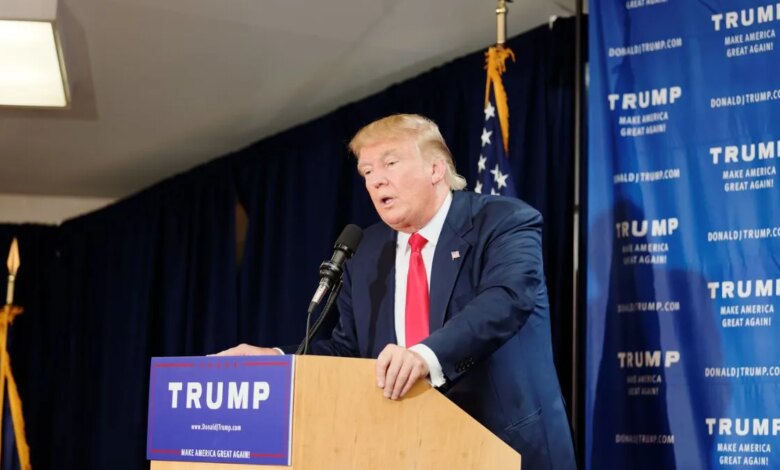

“Donald Trump Laconia Rally, Laconia, NH by Michael Vadon July 16 2015” by Michael Vadon is licensed under CC BY-SA 2.0.
Trump’s tariffs will continue..

|
President Trump used his State of the Union address to respond to a recent Supreme Court ruling, calling it “unfortunate” before quickly laying out his new plan for tariffs. Just days before the address, the Supreme Court struck down most of the tariffs Trump had put in place in 2025 under the International Emergency Economic Powers Act (IEEPA), dealing a serious blow to a central part of his economic agenda.
Right after the ruling, Trump signed an executive order to introduce a 10% “global tariff” using Section 122 of the Trade Act of 1974. Unlike the IEEPA tariffs, these new duties can stay in place for 150 days without needing approval from Congress. “They’re a little more complex, but they’re actually probably better, leading to a solution that will be even stronger than before. Congressional action will not be necessary,” Trump said at the State of the Union.
According to Business Insider, Trump also said he wouldn’t need to make new trade deals, suggesting other countries were already happy with existing agreements. He added, “It’s already time-tested and approved, and as time goes by, I believe the tariffs paid for by foreign countries will, like in the past, substantially replace the modern-day system of income tax, taking a great financial burden off the people that I love.”
The real cost of tariffs has largely fallen on American businesses and consumers
Under the previous IEEPA tariffs, the US collected around $129 billion in revenue. However, a study by the Federal Reserve Bank of New York found that “90% of the tariffs’ economic burden fell on US firms and consumers.” Companies are now trying to get refunds on tariffs they already paid, with some, like FedEx, filing lawsuits to recover their money.
The Supreme Court ruling and Trump’s response are coming at a time when many Americans are worried about the cost of living and the state of the economy. While the US economy grew by 2.2% in 2025, job creation has slowed down.
Economists have noted that this pattern is widening the gap between wealthy people and everyone else. Trump’s economic decisions are just one part of a broader set of controversies, as his recent social media attacks targeting a former First Lady have also drawn significant public criticism.
Public opinion reflects these concerns. A poll from February showed that most Americans disapprove of how Trump is handling inflation, tariffs, international relations, immigration, and the economy overall. Consumer confidence in February was more than 12% lower than it was in the same month in 2025.
Even though pessimistic expectations for the future have “eased somewhat,” confidence still remains “well below” the peak seen in November 2024. This points to a broader sense of financial pressure felt by many ordinary Americans. Meanwhile, tensions on other fronts are also rising, with Trump’s top general flagging serious risks of an Iran military strike adding to an already complex foreign policy picture.
With Trump’s new tariff approach now in motion, the focus will be on whether these Section 122 duties produce different results than the ones the Supreme Court struck down, particularly when it comes to who actually ends up paying the cost.





Published: Feb 25, 2026 02:45 pm